Country-Based Routing vs Split Tunneling: Which One Keeps Local Apps Working?
A VPN sends all your traffic through a server in another country. That is the point, and also the problem: local banks, government portals, delivery apps and streaming services in your own country start to think you are abroad. VPN providers have two main answers to this, and they are often confused.
Split tunneling: choose apps
Classic split tunneling works per app. You pick, say, your banking app and your taxi app, and those apps connect directly, without the VPN. Everything else goes through the tunnel.
Good for: a handful of apps you know about.
Weak spots:
- The same service opened in a browser still goes through the VPN.
- Payment pages and bank modules embedded in other apps are not covered.
- Every new local app has to be added by hand.
- On some platforms, app-level exclusion is limited or unavailable.
Country-based routing: choose countries
Country-based routing (also called geo routing, geo exclusion or GeoIP routing) decides by where the destination server is. If the site or service is hosted in your own country, the connection goes directly; if it is anywhere else, it goes through the VPN.
Good for: everyday use where you want all local services to just work.
Weak spots:
- It depends on an up-to-date GeoIP database; a local service hosted abroad (for example on a foreign cloud) will still go through the VPN.
- It does not help if the service blocks you for being physically abroad.
Side by side
| | Split tunneling (by app) | Country-based routing | |---|---|---| | What you choose | Apps | Countries | | Bank website in a browser | Through VPN | Direct | | Payment page inside another app | Through VPN | Direct | | New local app installed | Must add by hand | Covered automatically | | Local service hosted abroad | Direct if the app is excluded | Through VPN | | Setup effort | Medium, ongoing | One switch |
Who offers what
Most large VPNs offer split tunneling by app. Country-based routing is less common. Some providers have it under their own names, for example "Smart Mode" in Astrill or "Geo Exclusion" in NymVPN.
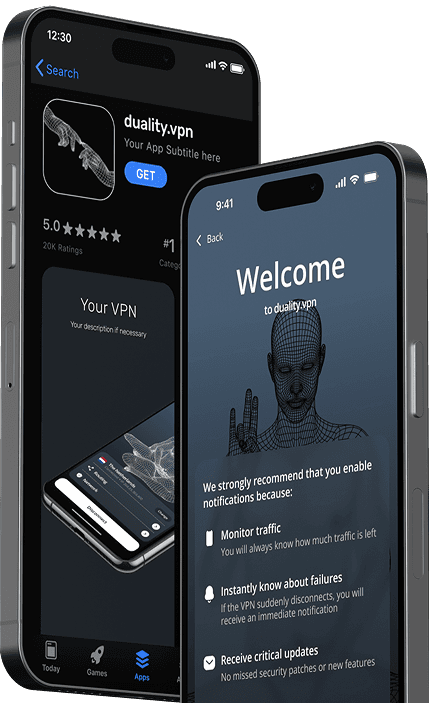
In Duality VPN it is a switch in Routing: "Exclude VPN traffic routing within my current country" sends the traffic of the country you are in directly, and Custom routing lets you add more countries to Bypass or send a chosen country through a specific server (Direction). Country routing is part of the Premium plan.
Which one should you use?
- You mostly need your bank and a couple of local apps to work: either will do; country routing is less maintenance.
- You use local services in the browser a lot: country routing.
- You want one specific app to always skip the VPN, wherever it connects: split tunneling.
- You live in one country and bank in another: country routing with that country added to the bypass list.
Both are legitimate ways to keep local services working while the rest of your traffic stays private. Neither makes you appear to be somewhere you are not, and neither should be used to get around a service's location rules.